Culture · 6 May 2026
Why the DeLorean Time Machine still works 40 years on
A reflection on why a 1985 car is still one of the most powerful advertising and cultural icons going — and what that means if you put one in your event.
Back to the Future opened in July 1985. Forty years ago. And yet, at every brand activation, every wedding, every birthday where the DeLorean Time Machine appears, the reactions are exactly what they would have been in 1986: phones up, kids frozen, parents shouting “no way!”. What is it about this car that four decades hasn’t worn down?
Short version: the film is about a real car turned into a time machine
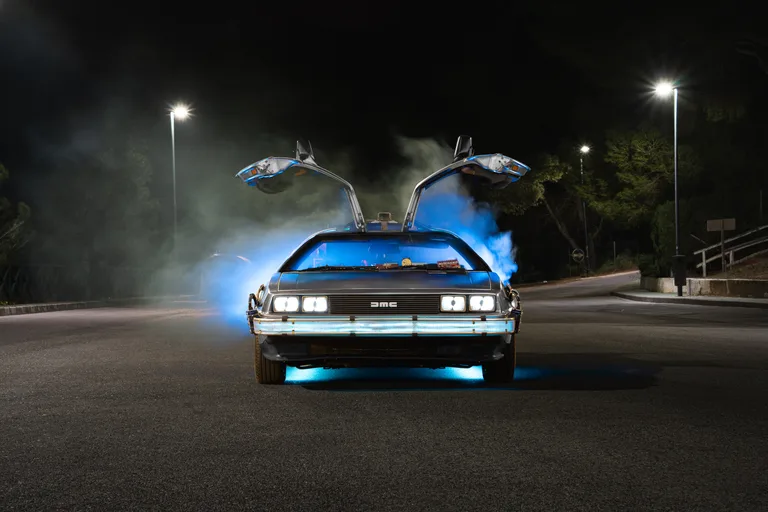
Almost every cinematic icon is locked into the fictional universe of its film. The Star Wars X-wing doesn’t intersect with your daily life. Superman’s cape doesn’t either. But the DeLorean is a real car that existed, that you could buy at dealerships in the 1980s, and that Robert Zemeckis chose to turn into a Time Machine precisely because of that — because when you saw one drive past on the street, you’d hesitate for a second on whether it was a normal car or not.
That property is what keeps the magic alive: the DeLorean Time Machine is an object that could exist in your world. People understand it as a possibility, not as an abstract symbol.
Why nostalgia works as a marketing tool
There are decades of academic marketing literature on this, but the summary is simple: nostalgia activates brain regions associated with positive emotion and youth. It’s the reason brands still use 80s music, 90s aesthetics, retro formats. It works because the target audience for most marketing is the generation now turning 35-55, exactly the generation that grew up with Back to the Future.
This shifts for campaigns aimed at Gen Z (where the DeLorean works less as nostalgia and more as discovery — but still works). For almost everything else though — weddings, birthdays, B2B launches, premium retail — the target is Gen X and millennials. Exactly the segment for whom the DeLorean is pure nostalgia.
What that means for your event
If you’re organising an event — a wedding, a birthday, an activation — and you’re hesitating about whether the DeLorean’s cost and logistics are justified, here’s the most useful metric: how many of your guests/visitors have seen Back to the Future at least once?
- For a wedding with guests aged 35 to 65: probably 95%.
- For a brand activation in a shopping centre: probably 80% of relevant footfall.
- For a 50th birthday surprise: 100%.
Every one of those guests or visitors carries a pre-built emotional association with the car. You don’t have to create the emotion — you just have to trigger it.
The DeLorean in 2026 vs the DeLorean in 1985
A reasonable question: if the film is 40 years old, isn’t the icon wearing out? Shouldn’t we be looking for more recent references?
The empirical answer is no, for two reasons. First, the trilogy is still active culture: streaming platforms keep it in rotation, new generations are discovering it through TikTok and memes, theatrical re-releases fill cinemas. Second, cultural icons don’t age the way fashions do: the White House, the Eiffel Tower, the Coca-Cola bottle — these are references that gain weight over time, not lose it. The DeLorean Time Machine is firmly in that category.
If anything, 40 years of distance has shifted the car from “recent pop icon” to “cultural heritage”. People don’t associate it with a passing fashion — they associate it with their childhood, their teenage years, their first memories of cinema. That association is far deeper and far more durable.
Practical takeaway
If you’re hesitating about whether the DeLorean is the right choice for your event, look at your guests. If most are aged 30 to 65, yes it is. The investment pays itself back on the first photo.
Want to see what it would look like at your event? Ask us for availability or talk to Doc Brown for a quick cost estimate.